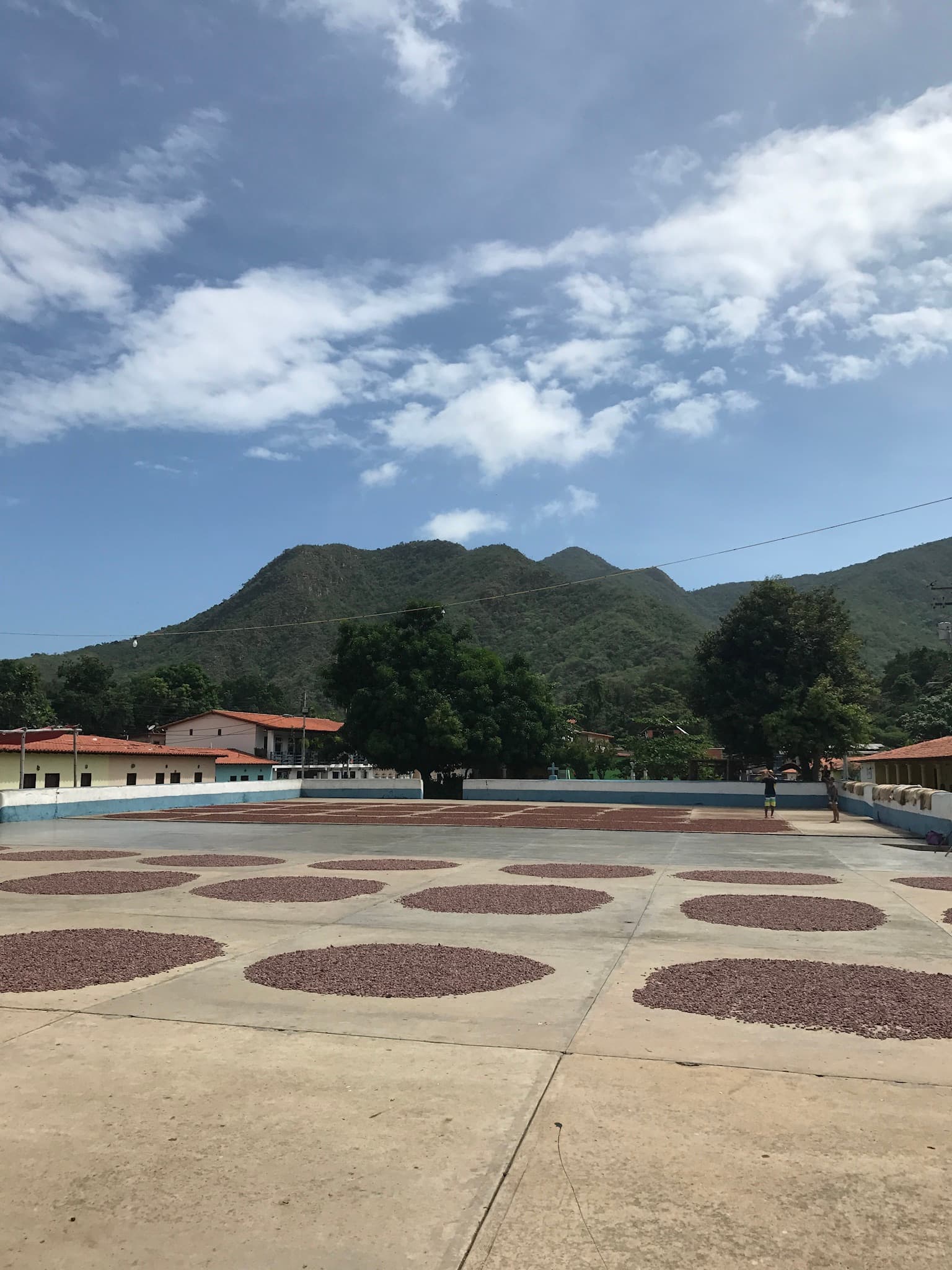
Photo: Bucare2011, CC BY-SA 4.0

Cacao and gastronomy
Venezuela's cacao has a long-standing reputation among chocolatiers, built partly on the country's Criollo-lineage beans and partly on the story of one particular village: Chuao, on the coast of Aragua state, reachable only by boat from nearby Choroní.
Chuao
Cacao has been grown at Chuao since at least 1591, predating the town itself, founded in 1660. The village's isolation — mountains and rainforest to the south, the sea to the north, no road access — has helped preserve an old, distinct cacao stock relatively undisturbed by outside crossbreeding. In 2000, Venezuela granted "Cacao de Chuao" an official Denominación de Origen, restricting the name to cacao genuinely grown in this specific valley — one of relatively few cacao-producing regions anywhere with this kind of protected-origin status.
Chuao's cacao is still grown, harvested, fermented and sun-dried largely by hand, without additives. The drying happens in the open air, on the paved courtyard in front of the town's colonial-era church, built in 1772 — a scene that has reportedly changed very little in generations.
Criollo
Venezuelan cacao is closely associated with the Criollo lineage — long prized by chocolatiers for a milder, more aromatic flavor than other cacao types, though it now accounts for only a small share of global cacao production. The popular idea that Venezuela is the historic "birthplace" of Criollo cacao is more a matter of naming and long cultivation than settled botanical fact — genetic research treats Criollo, alongside categories like Forastero and Trinitario, as a broad working label rather than a single strict lineage.
On the table: what to look for in Caracas
Venezuelan food built around corn is the everyday backbone of eating in the city: the arepa (a grilled or fried cornmeal pocket, split and filled — cheese, avocado, shredded beef, whatever's on hand) and the cachapa (a sweet corn pancake, traditionally paired with soft queso de mano). Pabellón criollo — shredded beef, rice, black beans and fried plantain on one plate — is considered the national dish, and hallacas (a corn-dough parcel filled with a meat stew, wrapped in plantain leaf) mark the Christmas season specifically. Tequeños — fried cheese-filled breadsticks, said to have been invented in 1912 in the nearby town of Los Teques — turn up everywhere from street stalls to sit-down restaurants.
For produce, the long-running Mercado de Quinta Crespo, opened in 1951 as Caracas's first market built for direct producer-to-consumer sales, remains one of the city's main food markets.
Updated — 8/4/2026
Content researched and verified by the Caracas Virtual team. See methodology